Digital Assets · Institutional Products · Strategy · Corporate Development

Markets change before institutions do.

My career is a story of inflection points in global capital markets. New financial technologies, product structures, and asset classes appear at the edge of markets, then meet fierce resistance from incumbents before achieving institutional adoption. While these regime changes appear unique in isolation, predictable patterns are consistently repeated. Understanding these patterns is critical to success in our evolving global capital markets.

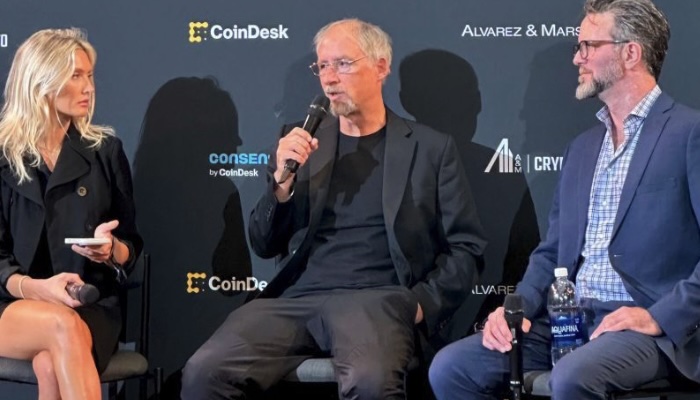
Phil Barkett onstage with Blockstream CEO Adam Back during a fireside conversation moderated by Casey Craig
With Adam Back and Casey Craig
Consensus Miami · May 2026

01 / Perspective

Transformative paradigms.
Evolutionary outcomes.

Technology is constantly evolving in its application across market sectors. Long-established standards and structures within each sector are being challenged in parallel, slowly at first, then snowballing as institutional thought leaders gain comfort with each new paradigm. We see this in financial services not only through fintech, but in asset classes, investment vehicles, and the exchanges that facilitate markets. In each instance, institutional adoption is not a moment, but rather a process.

This process begins when innovators produce an edge that early adopters follow. Progress is met with resistance from incumbents who mislabel innovation as risk. Hurdles are subsequently overcome and professionals separate from opportunists. Advisors establish frameworks to educate their clients. Lobbyists lobby, then regulators regulate or legislators legislate. Risks become quantifiable, incentives align, and premier LPs amend their investment policy statements.

Then, more often than not, adversaries and the aforementioned incumbents become target markets for new product development.

Equities traded in 1/16 fractions before ECNs matched bids and offers, and gold traded at $450/oz before commodity ETFs improved investor access. The hedge fund industry was measured in the billions, not trillions of dollars, before public pensions began funding the alternative asset class.

Digital assets and cryptographic infrastructure are now moving through this progression. The useful question is not whether the technology is interesting or where the asset is priced. It is whether the economics are durable, the incentives align, and the risks can be both quantified and justified.

Thought leaders in digital assets must guide institutional LPs down this predictable path. While cryptographic infrastructure is a sell-side game, nothing moves the sell side like the buy side.

02 / The arc

A career of catalysts that evolved capital markets.

1997

Markets become electronic

Townsend Analytics democratized market access and modernized capital markets with Archipelago and RealTick. Starting in support before becoming an AE, Townsend was a front-row seat to the modern era’s first fintech revolution.

2004

Commodities broaden access

Commodity ETFs launched within weeks of my joining CPM Group. These structures eroded barriers to precious metals markets, created an institutional asset class, and broke long-established econometric forecasting models in the process.

2006

Hedge funds onboard public LPs

Consultants had begun adopting hedge funds as an asset class for public LP portfolios as I joined EnTrust. GPs competed for every dollar as assets ballooned into the trillions. Experienced LPs later sought strategic partnerships over commingled funds, and Lighthouse was perfectly positioned.

2013

Bitcoin looks familiar

My first Bitcoin transaction revealed an order book inspired by Townsend’s RealTick. It added a market that never closed and a new, more efficient method for assigning and storing value. My exposure to DeFi in 2020 convinced me that a paradigm shift would develop.

2025

Digital assets become infrastructure

As VP of Enterprise at Blockstream, my combined work experiences allowed me to quickly evaluate commercial opportunities, prospective deals, and product requirements as the financial sector’s interest turned from asset price to asset utility.

03 / Global perspective

Companies operate globally. So do their capital markets.

Institutional vernacular changes by market and jurisdiction. The underlying work does not: get to know the decision-makers, appreciate the incentives that motivate them, and understand the risks they are paid to avoid.

04 / Focus

Where experience changes the quality of the decision.

The work is rarely confined to one function. Product, capital, regulation, distribution, technology, and organizational politics usually arrive at the table together.

01

Go-to-market strategy

Positioning technically complex products for banks, custodians, asset managers, and other financial institutions.

02

Acquisitions & strategic investments

Evaluating strategic fit, technology, economics, integration milestones, regulatory risk, and the assumptions beneath best/base/worst ROI.

03

Strategic partner and service provider selection

Looking beyond immediate revenue to incentives, operating fit, risk exposure, and long-term optionality.

04

Board & executive decisions

Turning complex, multi-stakeholder questions into quantifiable risks relative to expected reward and outlining clear, defensible paths forward.

05

Blockchain infrastructure

Sourcing custody, tokenization, smart contracts, and interoperability to institutional specifications.

06

Tokenization strategy

Separating technically possible from commercially viable, with attention to implementation and evaluation of primary and secondary markets.

07

Institutional capital formation

Understanding how allocators, consultants, investment committees, and fiduciaries adopt unfamiliar strategies.

08

Contracts & commercial terms

Aligning economics, service obligations, governance, incentives, and risk allocation in negotiated agreements.

05 / Market context

Global Market Indices

Portrait of Phil Barkett

06 / About

Phil Barkett

Co-Founder & Principal, AMC llc

My career spans financial technology, institutional capital formation, alternative investments, corporate development, and digital-asset infrastructure. The formative years of my career were spent with a company that revolutionized equity markets. After earning my MBA, I spent more than a decade sourcing capital and building products for two leading hedge fund managers as industry AUM ballooned from public fund adoption.

In 2013, I purchased my first Bitcoin, and I spent the solitude of the 2020 pandemic trading across multiple ecosystems in what became known as DeFi Summer. Since then, I have examined digital assets through the lenses of market structure, institutional adoption, product strategy, public policy, and commercial execution. Most recently, I served as Vice President of Enterprise at Blockstream and sat on the company’s Executive, M&A, Product, AI, and Pricing Committees.

My value contribution is in deconstructing complexity and aligning interests when there are multiple stakeholders, improperly positioned incentives, and material risk in not making the optimal decision.

CAIAMBA, Finance & InvestmentsSan Francisco
San Francisco skyline and Bay Bridge at night

San Francisco, California

07 / Contact

Outside perspectives improve team decisions.

If you and your IC, EC, business unit, or board are navigating the complexities of digital assets, institutional products, strategy, or corporate development, I would be glad to hear what you are working through.

AMC is currently interested in speaking with the following domain experts: regulatory regime specialist – UK, tokenization specialist – Hyperliquid, stablecoin specialist – Hong Kong.

Please do not include confidential or nonpublic information.